HMS Illustrious passes Coulport earlier this month
The Clyde bases that host Britain’s nuclear bombs and submarines are plagued by widespread safety flaws, according to an internal Ministry of Defence (MoD) report obtained by the Sunday Herald.
Critics fear that the problems could trigger a major nuclear accident at Faslane or Coulport that would contaminate Glasgow with radioactivity. They say this would be “unspeakable” and are demanding an urgent investigation.
The MoD’s latest annual review of safety reveals that 11 of the bases’ 13 activities have been officially declared unsatisfactory after assessments by site managers and regulators. The review was released last week in response to a request under freedom of information legislation.
Nine safety activities were colour-coded yellow because they were “below standard” and suffered “some specific weaknesses”. These included categories headed “weapons safety”, “safety culture”, “maintenance”, “safety performance indicators”, “site safety case”, “nuclear safety event reporting” and “conventional health and safety including fire safety”.
Two activities were coded orange because they were “significantly below standard” with “flawed” practices or procedures. They were headed “organisational change” and “operator experience feedback”.
No further details about the precise nature of the safety weaknesses were given in the review, or by the MoD. On nuclear weapons safety the review just said there had been “shortfalls in specific areas or delays in progressing projects”.
The revelations were “of grave concern”, according to the SNP’s defence spokesman in Westminster, Angus Robertson MP. “They point to serious systemic failures which could clearly put lives at risk,” he said. Continued…
Reproduced by permission of Sunday Herald environment correspondent Rob Edwards.
For those of you who regularly read this site, you will already be aware that aerial spraying took place over Ardentinny, for the second year running, in July of this year. This happened without any apparent forewarning, despite an undertaking from Forestry Commission Scotland (FCS) last year that notice of any future aerial spraying would be communicated to the public, in advance. Consequently Ardentinny.org contacted FCS and there ensued various correspondence, all reported here, regarding whose responsibility it was to inform the public and who had done what, in that regard. Two of our site visitors were kind enough to supply evidence of what was required by law in England and Wales and we checked with the Scottish Environmental Protection Agency (SEPA) and it confirmed that the rules regarding signage also applied in Scotland.
FCS then provided information supplied by the helicopter company, MFH Helicopters Ltd., who undertook the spraying, which said that warning signs had been posted but could give no further detail (see Aerial spraying – the future). As we were invited to deal directly with Mr. Hawkings-Byass of MFH Helicopters, we did so on 27 September, 2011 asking if his company retained the data required in their Aerial Application Certificate which was detail of the company’s procedures for the provision and positioning of warning signs within 60m of the land to be treated so as to warn pedestrians, drivers and others of the activity. In addition we asked: How many signs were posted; when they were posted, the wordage of the signs; and their exact location, preferably with map co-ordinates. Mr. Hawkings-Byass responded to say that he would reply to our questions on 3rd October. On hearing nothing further, on 11th October we wrote to the Civil Aviation Authority (CAA) requesting said information, in the knowledge that it is one of their requirements when issuing the appropriate license.
On 14 October we received the following response from MFH Helicopters Ltd:
I apologise for the delay in replying but I have been away. I am sorry that I am not able to produce much more information than I have already. As I have stated already we are not obliged to keep records of where and when signs are posted. All our ground vehicles carry such signs.
Since the regulation was introduced, open access has required us to re-evaluate the measures we take with regard to 3rd parties and these will be particular to each location and its relevant circumstances.
Kind regards,
Nicholas Hawkings-Byass
and on the 26th October we received the following response from the CAA:
MFH Helicopters are granted their annual Aerial Application Certificate on the basis of a number of items including an Operations Manual that states how the spraying operations are to be conducted. In compiling this manual the guidance in our CAA publication CAP 414“The Aerial Application Certificate” is followed, which states,amongst other things, how warnings should be posted to nearby residents etc. I can confirm that the MFH Operations Manual does contain instructions to its crews to post warning notices on public roads and footpaths within 60m of the boundary of the land to be treated.
The CAA carry out an annual inspection (audit) of the field operations of Aerial Application Certificate holders including MFH. The most recent inspection took place in July of this yea rand there were no findings that would have justified suspending MFH’s certificate.
I understand that you are having a constructive dialogue with MFH in order to ensure that the warning signs are posted where they can be readily seen and fulfil their purpose. If the warning sign system is not proving effective we would reasonably expect MFH to use additional media(websites/local liaison etc)to ensure fair warning is given and the local effected local populace are aware of what is taking place.
Regards,
Lawrence Hay
Encouraged by the CAA’s approach to ‘ensuring fair warning is given and the local effected populace are aware of what is taking place’ we asked if the CAA would communicate this to HMF Helicopters as, apart from Community Council members, it seemed that neither the local residents, nor the general public visiting the village on the day the spraying took place, were aware of it and that hill and forest walkers at the time reported they saw no warning signs. On 1 November, 2011 we received this response from Mr. Lawrence Hay of the CAA:
I will discuss the use of additional media with MFH and they were copied in on my last e-mail to you. I am having a regular dialogue with MFH on the future of aerial spraying as this has been under threat due to various EU decisions. The UK is seeking to continue having aerial application of asulox/asulam as an option since its only present use here is for this type of conservation work. The use of helicopters is regarded as less invasive in remote environmentally sensitive areas (typically rural hill sites and moors) because they do not have to use tracks and paths or leave a surface ‘footprint’.
I note that the Community Council did not have the opportunity to pass on information to the residents of Ardentinny and that some of the posted signs were missed. From my dealings with other operators, this problem of communication is one of the hardest to get right especially as they are at the sites for a very brief time; it may well be that some of the places that signs are posted are not the same places that would be obvious to those with local knowledge.
It would help if a local liaison point/person were established so that prior to operations, critical information could be passed on to the right people and the benefit of local knowledge obtained.
Regards,
Lawrence Hay
While the lack of forewarning of spraying, which should include the name of the substance being employed, has been our main concern, it is interesting to note that the chemical used appears to be of concern on many fronts, though perhaps for different reasons. However, it is heartening to see that there is a will to overcome past failures to forewarn the public and to ensure that this does not recur.
As aerial spraying has taken place in Ardentinny on two occasions in as many years without apparent forewarning to residents and visitors, Ardentinny.org has tried to ascertain what should happen should spraying take place in the future.
Following up on the information provided by two of our site visitors regarding the need for signage when aerial spraying is taking place, we contacted SEPA to clarify what regulations are in force in Scotland. We received a reply from Gayle Howard, their Media Officer – Communications who said she had checked with her colleagues in their land unit and that they had confirmed that the regulations do apply in Scotland and that it is a legal requirement that signs be erected.
We subsequently copied this to Russell Lamont of Forestry Commission Scotland, inviting comment. On the 12th September Russell Lamont replied saying that the helicopter team concerned had been consulted and that they had responded saying that appropriate measures to exclude the public from the spraying area were taken and this included the posting of signs. We followed this up requesting the following:
– How many signs were posted?
– When the signs were posted.
– The wording of the signs.
– Where the signs were located (map coordinates).
On 30th September Russell Lamont provided us with this response from Nicholas Hawkings-Byass of MFH Helicopters Ltd.:
‘I am afraid the question you have asked I cannot answer with any further accuracy since we are not obliged nor would we see any need to keep such records of where such signs are posted or alternative measures that may be taken. Please also bear in mind that after nearly 25 years of aerial spraying this is the first time that such information has been asked of us. I do not know the reason behind this request for information but if it is based on concerns with Asulam and aerial spraying then I would be more than happy to address these directly.’
It is our understanding that the aerial spraying company when applying for the Civil Aviation Authority (CAA) Aerial Application Certificate should detail the company’s procedure related to warning signs:
‘5.1.11 Warning Notices
The manual should detail the company’s procedures for provision and positioning of warning signs required to be placed within 60 m of the land to be treated so as to warn pedestrians, drivers and others of the activity.’
As Mr. Hawkings-Byass offered to deal directly with our enquiries, we wrote to him on 27 September and have received a response saying he will deal with the matter on Monday 3rd October. We continue to copy all correspondence on this issue to Russell Lamont of Forestry Commission Scotland and will report any further findings here.
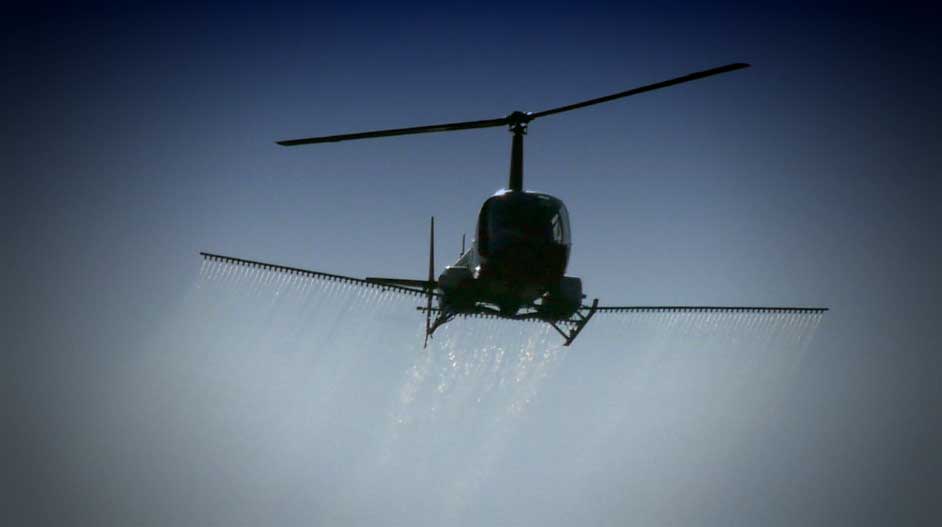
As local residents will have seen on Tuesday (26 July), a helicopter was spraying the hills above Ardentinny forest. A similar operation was carried out in August last year. At that time Russell Lamont, the FCS Environment Manager, assured us that the community would be advised of future spraying operations. Unfortunately this did not happen.
Cowal & Trossachs Forestry Director, Gordon Donaldson has informed us that FCS had been contacted regarding the spraying but was unsure as to whether the contact was made by David Marshall or the contractor carrying out the work.
Gordon Donaldson said “When the contact was made the date and time of the work was not known as this is dependent on the weather, however Russell reminded them to contact the local community and other departments to keep them informed. Unfortunately, from your contact and the number of calls we fielded on the day, this has clearly not been done. I have made contact with David by email informing him that in future he must do this”. He continued “I am sorry that contact has again not taken but can confirm that the work being done was similar to that outlined by Russell last year in his email contact with you then”.
Considering that the aerial spraying was undertaken on what was one of the hottest days so far, the likelihood of walkers being in the vicinity was very real. The lack of any advance notice to the community or any form of warning signage in the area is an issue of concern.
Update 1 August
We have today received the following correction from Gordon Donaldson, FCS:
Contrary to the supposition of my email to you, when I deduced from the number of calls we received about the spraying that community contact had not been made, I am now able to correct that position.
David Marshall has contacted me and he has informed me that both the Ardentinny and the Benmore and Kilmun CC’s were informed of the intention to spray, by email on the 12th July 2011. He also intimated to me that neither CC made any comment in response to the contact. In addition he confirmed that SEPA and the MOD were fully informed of the planned helicopter spraying.
I should also add that spraying of this kind is not effective in wet weather so any planned spraying needs to wait for a suitable weather window and therefore can not be set by date and time.
We have contacted Ardentinny Community Council inviting their comment on this issue.
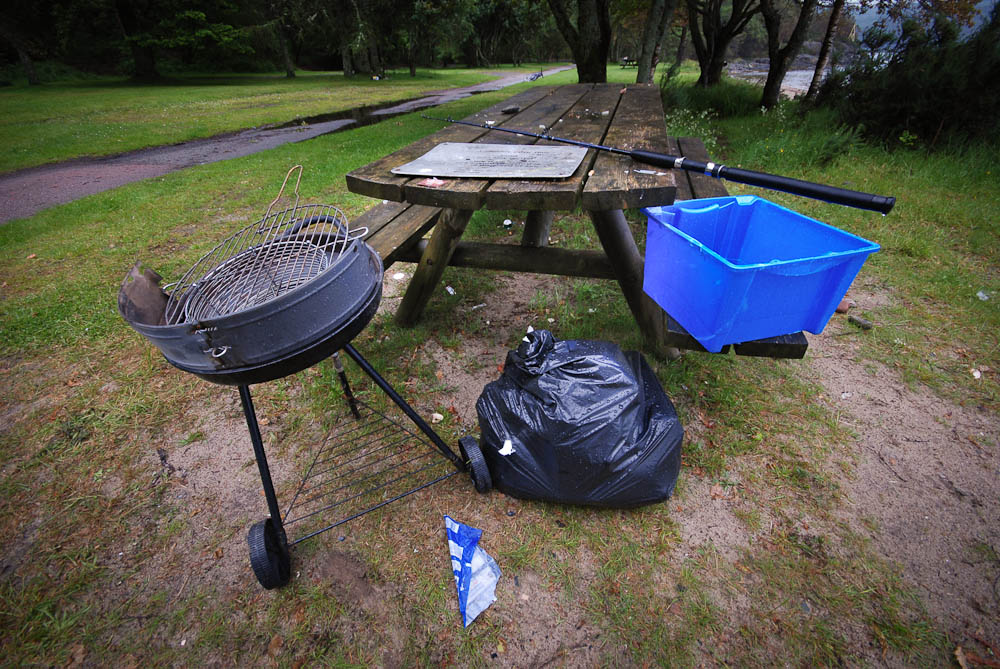
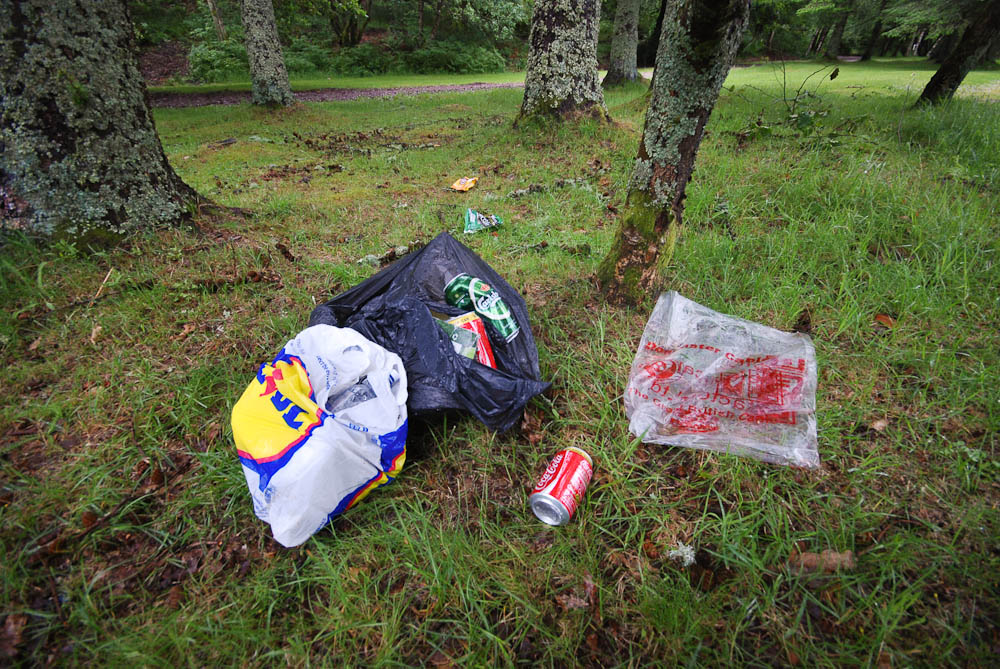
It may not have been the ideal weekend weather-wise for a picnic at the beach, nonetheless we were intrigued as to who was responsible for abandoning their partly-cooked bangers on the barbie along with unopened bottles and cartons of orange juice, water and even a full tin of mandarin oranges! Not to be outdone, fellow campers left a complete bbq, fishing rod, tarpaulin, plastic box, full rubbish bags and even a wood saw! These people don’t come unprepared.. a pity they can’t take it all home with them!